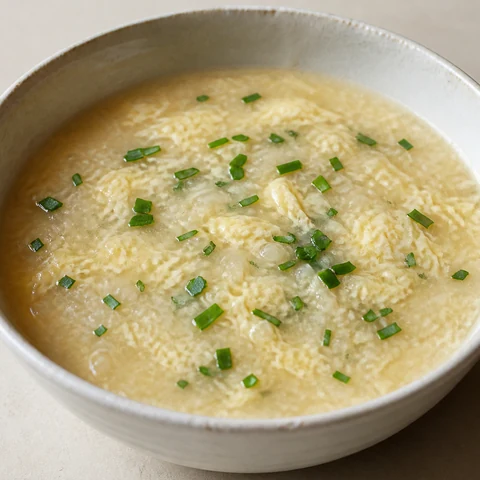
White rice simmered slowly in a little over three times its weight in liquid until the grains burst and dissolve, with beaten egg poured in at the end so it sets in fine threads.
On phones and tablets, Share can also offer installed messaging and social apps.
Prep 5 minCook 60 minServes 2
Ingredients
Why metric?
Metric avoids regional spoon ambiguity. US uses 5 mL tsp, 15 mL tbsp and 240 mL cup. Small masses stay in grams unless a verified recipe conversion exists. More on measurements
200 g white rice (dry)
180 ml reduced-salt chicken stock (180 g)
460 ml water (460 g)
4 eggs (204 g)
10 g fresh ginger, finely grated
10 g chives, finely snipped
8 g reduced-salt soy sauce
12 g sesame oil
15 g unsalted butter
Method
Rinse the rice under cold water until it stops running cloudy, then put it in a large saucepan with the stock, the water and the ginger. Use a bigger pan than looks necessary; congee climbs the moment it catches a proper boil.
Bring to the boil, then drop to the lowest heat that keeps one lazy bubble breaking the surface, and set the lid on ajar.
Cook 50-60 minutes, stirring every ten minutes and scraping the base each time. It is ready when the grains have burst and gone and the pot looks like a loose, faintly glossy cream rather than rice sitting in water. A grain lifted on the spoon should smear to nothing under your thumb.
Beat the eggs in a cup. Take the pot off the heat, stir it into a slow whirlpool, then pour the egg in a thin stream around the edge while stirring gently. It sets into fine threads within seconds; stirring hard breaks those threads into powder instead.
Stir in the soy sauce, the butter and the sesame oil, and ladle into two bowls with the chives scattered over. The fat is not a garnish here; it is a good part of what turns rice and water into a meal worth the hour it took.
It thickens as it stands, so loosen the second bowl with hot water when you come back to it. This is a large bowl of a fairly thin thing, so it suits mornings when volume is not the problem; on mornings when it is, halve it and eat the rest at eleven.
Safety and storage
Keeps
2 days refrigerated below 5°C
Reheat to
steaming hot, at least 60°C
Cooked rice and pasta keep two days rather than three, so this dish takes the shorter time. Cool and cover within two hours, split large amounts into shallow containers, and reheat until steaming hot, at least 60°C.
These options describe ways to change the workload around a written recipe method. They do not certify a recipe as accessible or safe for a particular person, and they do not silently rewrite the canonical ingredients, quantities, cooking temperatures or food-safety requirements. Trial the real task and use a different method or recipe when a generic workflow change would be inappropriate.
Workflow option
Reduce peak lifting and transfer load
This method has at least moderate lifting or transfer demand, so the heaviest loaded step is worth planning before cooking begins.
Consider: Where the method allows it, consider smaller cookware, split cold loads, sliding across a stable surface or a prepared landing zone rather than carrying one awkward load.
Trade-offs
Splitting a load can add trips, pours or cleanup, so it is useful only when the complete sequence is easier to control.
Hot transfers need a clear destination and should not be improvised after the vessel is already loaded.
This method contains a recorded hot-liquid transfer, so route, load and landing position matter more than simply shortening the written step.
Consider: Clear the destination and route first; reduce the load only when that genuinely simplifies the sequence. If the transfer remains the main barrier, compare recipes whose canonical methods do not contain one.
Trade-offs
Extra pours can create additional spill opportunities even when each container is lighter.
A shorter route is not useful if it ends at an unstable or unreachable landing surface.
Recipes whose current method review records low visual reliance, making them useful examples when comparing methods that depend less heavily on visual checking.
Recipes whose current method uses no more than one cooking vessel, which may reduce pan handling and cleanup without guaranteeing a lighter overall task.
The recipe names the option of splitting the sitting, which is the logistics problem this essay says the one-line instruction hides.
Rice Congee with Soft Egg and Ginger
Serves 2 · Prep 5 min · Cook 60 min
White rice simmered slowly in a little over three times its weight in liquid until the grains burst and dissolve, with beaten egg poured in at the end so it sets in fine threads.
Ingredients
200 g white rice (dry)
180 ml reduced-salt chicken stock (180 g)
460 ml water (460 g)
4 eggs (204 g)
10 g fresh ginger, finely grated
10 g chives, finely snipped
8 g reduced-salt soy sauce
12 g sesame oil
15 g unsalted butter
Approximate per serving
2453 kJ / 586.3 kcal · protein 20.4 g · carbohydrate 75.2 g · fibre 1.2 g · fat 21.9 g · sodium 523.4 mg
Method
Rinse the rice under cold water until it stops running cloudy, then put it in a large saucepan with the stock, the water and the ginger. Use a bigger pan than looks necessary; congee climbs the moment it catches a proper boil.
Bring to the boil, then drop to the lowest heat that keeps one lazy bubble breaking the surface, and set the lid on ajar.
Cook 50-60 minutes, stirring every ten minutes and scraping the base each time. It is ready when the grains have burst and gone and the pot looks like a loose, faintly glossy cream rather than rice sitting in water. A grain lifted on the spoon should smear to nothing under your thumb.
Beat the eggs in a cup. Take the pot off the heat, stir it into a slow whirlpool, then pour the egg in a thin stream around the edge while stirring gently. It sets into fine threads within seconds; stirring hard breaks those threads into powder instead.
Stir in the soy sauce, the butter and the sesame oil, and ladle into two bowls with the chives scattered over. The fat is not a garnish here; it is a good part of what turns rice and water into a meal worth the hour it took.
It thickens as it stands, so loosen the second bowl with hot water when you come back to it. This is a large bowl of a fairly thin thing, so it suits mornings when volume is not the problem; on mornings when it is, halve it and eat the rest at eleven.
Safety and storage
Keeps
2 days refrigerated below 5°C
Reheat to
steaming hot, at least 60°C
Cooked rice and pasta keep two days rather than three, so this dish takes the shorter time. Cool and cover within two hours, split large amounts into shallow containers, and reheat until steaming hot, at least 60°C.
Meals built soft and small-particle, which is the dietary lever a recipe can genuinely control and one current guidance supports. Portion size is yours to set: these are written at an ordinary serving and divide in two if you are eating smaller and more often. Diagnosing, curing or treating gastroparesis is not something food does. If eating is not going in, if you are dehydrated or losing weight without meaning to, that needs a clinician rather than a different recipe.