Metric avoids regional spoon ambiguity. US uses 5 mL tsp, 15 mL tbsp and 240 mL cup. Small masses stay in grams unless a verified recipe conversion exists. More on measurements
4 slices soft white bread, crusts cut off (112 g trimmed)
3 eggs (153 g)
380 ml reduced-fat milk (391 g)
55 g skim milk powder
50 g cheddar, finely grated
150 g no-added-salt canned tomatoes
1 g dried thyme
10 g unsalted butter, for the dish
black pepper, to taste
Method
Heat the oven to 170C fan and butter a small baking dish generously.
Blitz the tinned tomatoes smooth, then push them through a sieve. It takes thirty seconds and it is the whole difference between a smooth custard and one with flecks of skin suspended in it.
Beat the eggs with the milk, the milk powder, the tomato, the thyme and some pepper. No salt goes in: between the bread and the cheddar there is already plenty.
Tear the trimmed bread into pieces no bigger than a thumbnail and scatter them in the dish with most of the cheese. Pour the custard over and press the bread under with the back of a spoon. Leave 20 minutes; the bread should go heavy and sink of its own accord.
Scatter the last of the cheese over and bake 30-35 minutes, until the middle is just set and stops moving in a wave when you shake the dish. Pull it before the edges brown hard, since a crisp edge is the one part of this that will not break down.
Rest 5 minutes before serving. What is left reheats well in a covered dish with a spoonful of milk poured over first.
Safety and storage
Keeps
3 days refrigerated below 5°C
Reheat to
steaming hot, at least 75°C
Cool it fast: split large amounts into shallow containers as soon as it stops steaming, and have it in the fridge within two hours. Reheat once only, until steaming hot right through, at least 75°C in the centre.
Recipes whose current method review records low visual reliance, making them useful examples when comparing methods that depend less heavily on visual checking.
Recipes whose current method uses no more than one cooking vessel, which may reduce pan handling and cleanup without guaranteeing a lighter overall task.
Serves 2 · Prep 10 min · Cook 35 min · Total 45 minutes, plus 20 minutes soaking
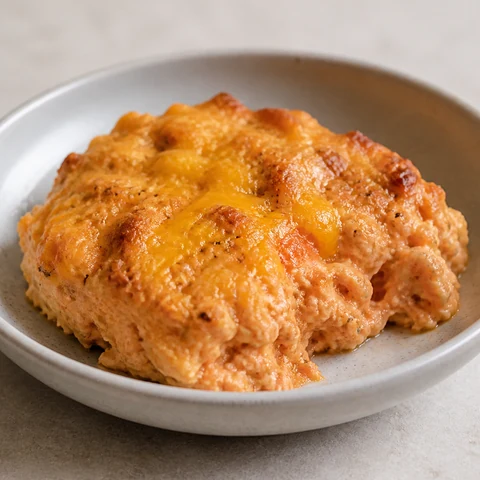
Torn white bread soaked in a cheese and tomato custard and baked until it just sets, closer to a savoury pudding than to anything with a crust on it.
Ingredients
4 slices soft white bread, crusts cut off (112 g trimmed)
3 eggs (153 g)
380 ml reduced-fat milk (391 g)
55 g skim milk powder
50 g cheddar, finely grated
150 g no-added-salt canned tomatoes
1 g dried thyme
10 g unsalted butter, for the dish
black pepper, to taste
Approximate per serving
2407 kJ / 575.4 kcal · protein 37.9 g · carbohydrate 53.4 g · fibre 2.7 g · fat 22.7 g · sodium 726.2 mg
Method
Heat the oven to 170C fan and butter a small baking dish generously.
Blitz the tinned tomatoes smooth, then push them through a sieve. It takes thirty seconds and it is the whole difference between a smooth custard and one with flecks of skin suspended in it.
Beat the eggs with the milk, the milk powder, the tomato, the thyme and some pepper. No salt goes in: between the bread and the cheddar there is already plenty.
Tear the trimmed bread into pieces no bigger than a thumbnail and scatter them in the dish with most of the cheese. Pour the custard over and press the bread under with the back of a spoon. Leave 20 minutes; the bread should go heavy and sink of its own accord.
Scatter the last of the cheese over and bake 30-35 minutes, until the middle is just set and stops moving in a wave when you shake the dish. Pull it before the edges brown hard, since a crisp edge is the one part of this that will not break down.
Rest 5 minutes before serving. What is left reheats well in a covered dish with a spoonful of milk poured over first.
Safety and storage
Keeps
3 days refrigerated below 5°C
Reheat to
steaming hot, at least 75°C
Cool it fast: split large amounts into shallow containers as soon as it stops steaming, and have it in the fridge within two hours. Reheat once only, until steaming hot right through, at least 75°C in the centre.
Meals built soft and small-particle, which is the dietary lever a recipe can genuinely control and one current guidance supports. Portion size is yours to set: these are written at an ordinary serving and divide in two if you are eating smaller and more often. Diagnosing, curing or treating gastroparesis is not something food does. If eating is not going in, if you are dehydrated or losing weight without meaning to, that needs a clinician rather than a different recipe.