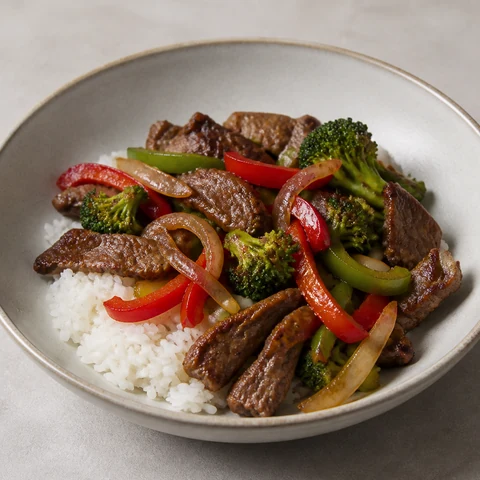
A stir-fry built on ginger, garlic and lime rather than soy sauce, because most soy sauce is brewed with wheat and this one needs no substitute to taste like something.
Metric avoids regional spoon ambiguity. US uses 5 mL tsp, 15 mL tbsp and 240 mL cup. Small masses stay in grams unless a verified recipe conversion exists. More on measurements
500 g beef stir-fry strips
300 g jasmine rice (dry), rinsed
2 capsicums, sliced (300 g)
300 g broccoli, cut into small florets
1 onion, sliced (150 g)
4 garlic cloves, chopped (20 g)
20 g fresh ginger, finely grated
35 ml neutral oil (32 g)
30 ml lime juice (30 g)
10 ml sesame oil (9 g)
2 g iodised table salt
Ground black pepper, to taste
Method
Rinse the rice, put it in a pan with 600 ml water and a tight lid, bring to the boil, then cook 12 minutes on the lowest heat and rest it 10 minutes off the heat without lifting the lid.
Pat the beef dry with paper towel and season it. Wet meat steams; dry meat browns, and this is the single thing that decides whether a stir-fry tastes of anything.
Get a wide pan or wok very hot with a third of the oil and cook the beef in two batches, 90 seconds a batch, moving it only once. Set it aside.
Add the rest of the oil, then the onion, capsicum and broccoli, and stir-fry 4-5 minutes over high heat. Add a splash of water and cover for 2 minutes to steam the broccoli through.
Add the garlic and ginger for 30 seconds, until they smell sharp rather than raw.
Return the beef with any juices, take the pan off the heat and toss through the lime juice, sesame oil, salt and pepper. Serve over the rice.
Serve
If you want the soy note, use a tamari labelled gluten free — ordinary soy sauce is brewed with wheat and is not safe here.
Safety and storage
Keeps
2 days refrigerated below 5°C
Reheat to
steaming hot, at least 75°C
Cooked rice and pasta keep two days rather than three, so this dish takes the shorter time. Cool it fast: split large amounts into shallow containers as soon as it stops steaming, and have it in the fridge within two hours. Reheat once only, until steaming hot right through, at least 75°C in the centre.
These options describe ways to change the workload around a written recipe method. They do not certify a recipe as accessible or safe for a particular person, and they do not silently rewrite the written ingredients, quantities, cooking temperatures or food-safety requirements. Trial the real task and use a different method or recipe when a generic workflow change would be inappropriate.
Workflow option
Reduce the chopping step before changing knife technique
If chopping is one of the heavier parts of this method, first check whether the same ingredient can be bought or prepared in a form that removes some knife work.
Consider: Compare pre-cut, frozen, pre-portioned or otherwise prepared versions only where they still perform the same culinary role in this recipe.
Trade-offs
Convenience formats can cost more or use more storage space.
Texture, seasoning, sodium or package size can differ, so check the actual product rather than assuming it is equivalent.
Some or all preparation may be separable from the heat-side work, even when the complete recipe cannot be performed from one position.
Consider: Stage ingredients and complete suitable measuring, opening and cold preparation at a stable seated station before the stove or oven is active, while keeping heat-side tasks as a separate plan.
Trade-offs
Moving prep can increase carrying if ingredients and tools are stored far from the seated station.
Perishable foods still require normal temperature control during staged preparation.
Recipes whose current method review records low visual reliance, making them useful examples when comparing methods that depend less heavily on visual checking.
A stir-fry built on ginger, garlic and lime rather than soy sauce, because most soy sauce is brewed with wheat and this one needs no substitute to taste like something.
Ingredients
500 g beef stir-fry strips
300 g jasmine rice (dry), rinsed
2 capsicums, sliced (300 g)
300 g broccoli, cut into small florets
1 onion, sliced (150 g)
4 garlic cloves, chopped (20 g)
20 g fresh ginger, finely grated
35 ml neutral oil (32 g)
30 ml lime juice (30 g)
10 ml sesame oil (9 g)
2 g iodised table salt
Ground black pepper, to taste
Approximate per serving
2395 kJ / 572.3 kcal · protein 44 g · carbohydrate 62.7 g · fibre 6.2 g · fat 14.2 g · sodium 260.4 mg
Method
Rinse the rice, put it in a pan with 600 ml water and a tight lid, bring to the boil, then cook 12 minutes on the lowest heat and rest it 10 minutes off the heat without lifting the lid.
Pat the beef dry with paper towel and season it. Wet meat steams; dry meat browns, and this is the single thing that decides whether a stir-fry tastes of anything.
Get a wide pan or wok very hot with a third of the oil and cook the beef in two batches, 90 seconds a batch, moving it only once. Set it aside.
Add the rest of the oil, then the onion, capsicum and broccoli, and stir-fry 4-5 minutes over high heat. Add a splash of water and cover for 2 minutes to steam the broccoli through.
Add the garlic and ginger for 30 seconds, until they smell sharp rather than raw.
Return the beef with any juices, take the pan off the heat and toss through the lime juice, sesame oil, salt and pepper. Serve over the rice.
Serve
If you want the soy note, use a tamari labelled gluten free — ordinary soy sauce is brewed with wheat and is not safe here.
Safety and storage
Keeps
2 days refrigerated below 5°C
Reheat to
steaming hot, at least 75°C
Cooked rice and pasta keep two days rather than three, so this dish takes the shorter time. Cool it fast: split large amounts into shallow containers as soon as it stops steaming, and have it in the fridge within two hours. Reheat once only, until steaming hot right through, at least 75°C in the centre.
Cooking for a diagnosed coeliac diet, where getting gluten out is the treatment and the rest is making that easy to live with. Diagnosis, testing and follow-up stay with your own team, and no recipe can vouch for your kitchen or a manufacturer’s production line.