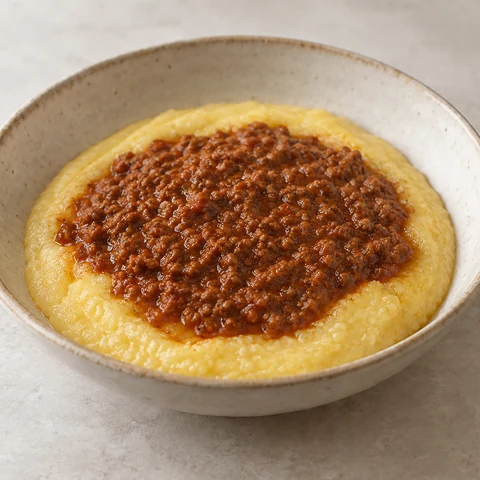
Lean mince simmered long and low with finely chopped mushrooms and a handful of red lentils until every piece crushes under a fork, in a tomato sauce that coats it, spooned over milk-cooked polenta soft enough to level itself on the plate.
Metric avoids regional spoon ambiguity. US uses 5 mL tsp, 15 mL tbsp and 240 mL cup. Small masses stay in grams unless a verified recipe conversion exists. More on measurements
30 ml extra-virgin olive oil (27 g)
1 medium brown onion, finely chopped (150 g)
1 medium carrot, finely grated (100 g)
250 g mushrooms, very finely chopped (a food processor is fine)
2 garlic cloves, grated (10 g)
500 g lean beef mince
20 g tomato paste
3 g dried oregano
1 x 400 g tin no-added-salt crushed tomatoes (400 g)
60 g red lentils, rinsed
500 ml reduced-salt beef stock (500 g)
1.5 g iodised table salt (about 1/4 teaspoon)
600 ml full-cream milk (618 g)
500 ml water (500 g)
180 g fine quick-cooking polenta
20 g unsalted butter
40 g parmesan, finely grated
Ground black pepper, to taste
Method
Warm the oil in a wide, heavy pan over medium heat. Cook the onion and grated carrot for 8 minutes until soft. Add the mushrooms and cook 6 minutes, stirring, until they have released their water and gone soft; do not cook them dry, and if they catch, add a splash of the stock. Add the garlic for 1 minute.
Add the mince and break it up with the back of a wooden spoon as it cooks, 6-8 minutes, until no pink remains and no piece is bigger than a pea. Small is not the same as tender: the long simmer that follows is what makes it soft.
Stir in the tomato paste and oregano for 1 minute, then add the tomatoes, lentils, 400 ml of the stock and the salt. Bring to a simmer, cover, and cook on the lowest heat for 35 minutes, stirring every 10 minutes and adding the remaining stock as it thickens. The lentils should have dissolved into the sauce. Test before serving: press a spoonful against the side of the pan and every piece of mince and mushroom should crush without resistance. If any is springy, simmer 10 minutes more with a splash of water. The mince must reach at least 75C/167F.
When the ragu has 20 minutes left, bring 500 ml of the milk and the water to a simmer in a saucepan. Pour in the polenta in a thin stream, whisking, and cook 5-8 minutes over low heat, stirring often, until smooth and thick like a loose porridge. Off the heat, stir in the butter and half the parmesan. Just before plating, stir in the remaining 100 ml milk, warmed, until it flows and levels itself; polenta sets within minutes, so do this last.
Spoon the polenta onto warm plates, make a hollow, and fill it with ragu so every spoonful has sauce with it. Stir the remaining parmesan into the ragu in the pan rather than scattering it on top. Season with pepper.
Serve
Polenta first, ragu on top, with enough sauce that nothing on the plate is eaten dry. Keep the polenta loose; polenta that sets firm asks the jaw to work. Lean mince can stay slightly springy however long it simmers: if a spoonful still resists on a bad day, press it through the sauce with the back of the spoon before eating.
Tomorrow
Ragu reheats well in a pan with a splash of stock or water until steaming hot. Polenta sets in the fridge; loosen it with milk over low heat, stirring, until it flows again.
Safety and storage
Cook to
75°C / 167°F in the centre (minced meat, hamburgers and sausages)
Keeps
3 days refrigerated below 5°C
Reheat to
steaming hot, at least 75°C
The Food Safety Information Council table gives minced meat, hamburgers and sausages as 75°C in the centre. Colour and clear juices are not a reliable test. Check the thickest part with a thermometer.
Cool it fast: split large amounts into shallow containers as soon as it stops steaming, and have it in the fridge within two hours. Reheat once only, until steaming hot right through, at least 75°C in the centre.
These options describe ways to change the workload around a written recipe method. They do not certify a recipe as accessible or safe for a particular person, and they do not silently rewrite the written ingredients, quantities, cooking temperatures or food-safety requirements. Trial the real task and use a different method or recipe when a generic workflow change would be inappropriate.
Workflow option
Reduce the chopping step before changing knife technique
If chopping is one of the heavier parts of this method, first check whether the same ingredient can be bought or prepared in a form that removes some knife work.
Consider: Compare pre-cut, frozen, pre-portioned or otherwise prepared versions only where they still perform the same culinary role in this recipe.
Trade-offs
Convenience formats can cost more or use more storage space.
Texture, seasoning, sodium or package size can differ, so check the actual product rather than assuming it is equivalent.
Identify the high-grip step instead of adapting the whole recipe
The recorded method includes at least moderate grip demand, but that demand may come from opening, stabilising, stirring, cookware or another specific step.
Consider: Identify the exact grip-heavy action and trial one change at a time, such as stabilisation, a lower-force opener or lighter cookware where that action actually occurs.
Trade-offs
A tool that reduces one grip demand can add setup, cleaning or another movement.
Do not assume a generic aid fits the hand position, force direction or hot-task sequence in this recipe.
Some or all preparation may be separable from the heat-side work, even when the complete recipe cannot be performed from one position.
Consider: Stage ingredients and complete suitable measuring, opening and cold preparation at a stable seated station before the stove or oven is active, while keeping heat-side tasks as a separate plan.
Trade-offs
Moving prep can increase carrying if ingredients and tools are stored far from the seated station.
Perishable foods still require normal temperature control during staged preparation.
Recipes whose current method review records low visual reliance, making them useful examples when comparing methods that depend less heavily on visual checking.
Lean mince simmered long and low with finely chopped mushrooms and a handful of red lentils until every piece crushes under a fork, in a tomato sauce that coats it, spooned over milk-cooked polenta soft enough to level itself on the plate.
Ingredients
30 ml extra-virgin olive oil (27 g)
1 medium brown onion, finely chopped (150 g)
1 medium carrot, finely grated (100 g)
250 g mushrooms, very finely chopped (a food processor is fine)
2 garlic cloves, grated (10 g)
500 g lean beef mince
20 g tomato paste
3 g dried oregano
1 x 400 g tin no-added-salt crushed tomatoes (400 g)
60 g red lentils, rinsed
500 ml reduced-salt beef stock (500 g)
1.5 g iodised table salt (about 1/4 teaspoon)
600 ml full-cream milk (618 g)
500 ml water (500 g)
180 g fine quick-cooking polenta
20 g unsalted butter
40 g parmesan, finely grated
Ground black pepper, to taste
Approximate per serving
3003 kJ / 717.8 kcal · protein 47.2 g · carbohydrate 55.5 g · fibre 7.9 g · fat 31.9 g · sodium 750 mg
Method
Warm the oil in a wide, heavy pan over medium heat. Cook the onion and grated carrot for 8 minutes until soft. Add the mushrooms and cook 6 minutes, stirring, until they have released their water and gone soft; do not cook them dry, and if they catch, add a splash of the stock. Add the garlic for 1 minute.
Add the mince and break it up with the back of a wooden spoon as it cooks, 6-8 minutes, until no pink remains and no piece is bigger than a pea. Small is not the same as tender: the long simmer that follows is what makes it soft.
Stir in the tomato paste and oregano for 1 minute, then add the tomatoes, lentils, 400 ml of the stock and the salt. Bring to a simmer, cover, and cook on the lowest heat for 35 minutes, stirring every 10 minutes and adding the remaining stock as it thickens. The lentils should have dissolved into the sauce. Test before serving: press a spoonful against the side of the pan and every piece of mince and mushroom should crush without resistance. If any is springy, simmer 10 minutes more with a splash of water. The mince must reach at least 75C/167F.
When the ragu has 20 minutes left, bring 500 ml of the milk and the water to a simmer in a saucepan. Pour in the polenta in a thin stream, whisking, and cook 5-8 minutes over low heat, stirring often, until smooth and thick like a loose porridge. Off the heat, stir in the butter and half the parmesan. Just before plating, stir in the remaining 100 ml milk, warmed, until it flows and levels itself; polenta sets within minutes, so do this last.
Spoon the polenta onto warm plates, make a hollow, and fill it with ragu so every spoonful has sauce with it. Stir the remaining parmesan into the ragu in the pan rather than scattering it on top. Season with pepper.
Serve
Polenta first, ragu on top, with enough sauce that nothing on the plate is eaten dry. Keep the polenta loose; polenta that sets firm asks the jaw to work. Lean mince can stay slightly springy however long it simmers: if a spoonful still resists on a bad day, press it through the sauce with the back of the spoon before eating.
Tomorrow
Ragu reheats well in a pan with a splash of stock or water until steaming hot. Polenta sets in the fridge; loosen it with milk over low heat, stirring, until it flows again.
Safety and storage
Cook to
75°C / 167°F in the centre (minced meat, hamburgers and sausages)
Keeps
3 days refrigerated below 5°C
Reheat to
steaming hot, at least 75°C
The Food Safety Information Council table gives minced meat, hamburgers and sausages as 75°C in the centre. Colour and clear juices are not a reliable test. Check the thickest part with a thermometer.
Cool it fast: split large amounts into shallow containers as soon as it stops steaming, and have it in the fridge within two hours. Reheat once only, until steaming hot right through, at least 75°C in the centre.
Real meals made mechanically easier to eat when chewing hurts. That is a job about texture and chewing rather than swallowing (dysphagia) guidance, and it is not a treatment for TMD itself.