Metric avoids regional spoon ambiguity. US uses 5 mL tsp, 15 mL tbsp and 240 mL cup. Small masses stay in grams unless a verified recipe conversion exists. More on measurements
280 g jasmine rice (dry)
500 g lean beef stir-fry strips
350 g cabbage, shredded
1 large red capsicum, sliced (200 g)
150 g carrots, cut into matchsticks
15 g fresh ginger, finely shredded
2 garlic cloves, finely chopped (10 g)
15 ml reduced-salt soy sauce (15 g)
27 ml neutral oil (25 g)
8 ml sesame oil (8 g)
60 g tahini
50 g almonds, roughly chopped
15 ml lime juice (15 g)
Ground black pepper, to taste
Method
Rinse the rice until the water runs clear, then cook it in unsalted water by whatever method you use. Keep it covered and off the heat while you cook the rest; it will hold for 20 minutes.
Whisk the tahini with the soy sauce, sesame oil, lime juice and 5 tablespoons of cold water until it is smooth and pours like cream. It will seize and stiffen when the first water goes in; keep whisking and it loosens again.
Toast the almonds in a dry wok or wide frying pan over medium heat, shaking constantly, until they smell nutty and are patched with gold. Tip them out.
Pat the beef thoroughly dry. Wet meat will not brown, it will grey. Get the pan very hot, add half the neutral oil and sear the beef in two batches for about 90 seconds each, turning once, until browned outside and still pink within. Tip each batch onto a plate.
Add the rest of the oil, then the carrot and capsicum. Stir-fry 2 minutes over the highest heat, keeping everything moving.
Add the cabbage, ginger and garlic and stir-fry a further 2-3 minutes. Stop while the cabbage still has snap and the edges are just starting to char; once it goes limp and grey the dish is over.
Return the beef and any juices to the pan, pour the sauce round the edge and toss for 30 seconds, until everything is coated and glossy. Grind over pepper, scatter the almonds on and serve over the rice.
Safety and storage
Keeps
2 days refrigerated below 5°C
Reheat to
steaming hot, at least 75°C
Cooked rice and pasta keep two days rather than three, so this dish takes the shorter time. Cool it fast: split large amounts into shallow containers as soon as it stops steaming, and have it in the fridge within two hours. Reheat once only, until steaming hot right through, at least 75°C in the centre.
These options describe ways to change the workload around a written recipe method. They do not certify a recipe as accessible or safe for a particular person, and they do not silently rewrite the written ingredients, quantities, cooking temperatures or food-safety requirements. Trial the real task and use a different method or recipe when a generic workflow change would be inappropriate.
Workflow option
Reduce the chopping step before changing knife technique
If chopping is one of the heavier parts of this method, first check whether the same ingredient can be bought or prepared in a form that removes some knife work.
Consider: Compare pre-cut, frozen, pre-portioned or otherwise prepared versions only where they still perform the same culinary role in this recipe.
Trade-offs
Convenience formats can cost more or use more storage space.
Texture, seasoning, sodium or package size can differ, so check the actual product rather than assuming it is equivalent.
Some or all preparation may be separable from the heat-side work, even when the complete recipe cannot be performed from one position.
Consider: Stage ingredients and complete suitable measuring, opening and cold preparation at a stable seated station before the stove or oven is active, while keeping heat-side tasks as a separate plan.
Trade-offs
Moving prep can increase carrying if ingredients and tools are stored far from the seated station.
Perishable foods still require normal temperature control during staged preparation.
Reduce visual identification and step-tracking load
This method leans heavily on seeing what is happening, so the useful change is usually to make the current ingredient, tool or step easier to identify rather than changing the food itself.
Consider: Use a consistent preparation zone and redundant identification or step cues that fit the cook’s preferred visual, tactile or audible workflow.
Trade-offs
More labels or cues can create clutter if they are not kept consistent.
A cueing system should support the real task; it is not a capacity or independent-safety assessment.
Recipes whose current method uses no more than one cooking vessel, which may reduce pan handling and cleanup without guaranteeing a lighter overall task.
Runs hot and fast from start to finish with no safe pause in it anywhere, which makes it a poor choice on an evening that will be interrupted; listed to illustrate a method demand and not an accessibility certification.
Concentrates heavy chopping into one block of time, which is the demand a food processor trade is usually made against; listed to illustrate a method demand and not an accessibility certification.
Short on the clock and unbroken at the cooktop from start to finish, which is the demand that decides the evening here; listed to illustrate a method demand and not an accessibility certification.
Community
Cooked this? Tell us how it went, and see what others changed.
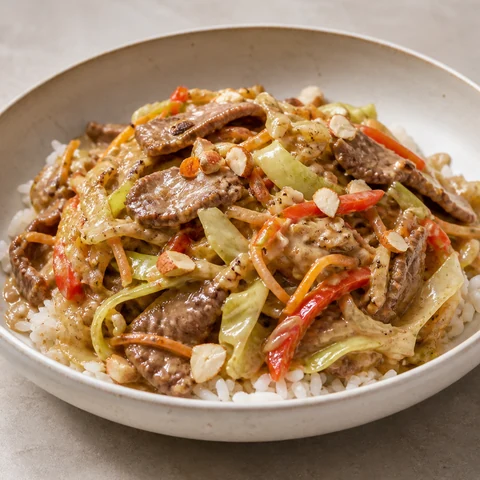
Ginger and Sesame Beef Stir-Fry with Cabbage and Rice
Serves 4 · Prep 20 min · Cook 20 min
Lean beef strips seared hard and tossed with cabbage, capsicum and carrot in a ginger, garlic and sesame sauce, with toasted almonds and rice.
Ingredients
280 g jasmine rice (dry)
500 g lean beef stir-fry strips
350 g cabbage, shredded
1 large red capsicum, sliced (200 g)
150 g carrots, cut into matchsticks
15 g fresh ginger, finely shredded
2 garlic cloves, finely chopped (10 g)
15 ml reduced-salt soy sauce (15 g)
27 ml neutral oil (25 g)
8 ml sesame oil (8 g)
60 g tahini
50 g almonds, roughly chopped
15 ml lime juice (15 g)
Ground black pepper, to taste
Approximate per serving
2890 kJ / 690.7 kcal · protein 46.9 g · carbohydrate 59.9 g · fibre 8.1 g · fat 27.2 g · sodium 225.9 mg
Method
Rinse the rice until the water runs clear, then cook it in unsalted water by whatever method you use. Keep it covered and off the heat while you cook the rest; it will hold for 20 minutes.
Whisk the tahini with the soy sauce, sesame oil, lime juice and 5 tablespoons of cold water until it is smooth and pours like cream. It will seize and stiffen when the first water goes in; keep whisking and it loosens again.
Toast the almonds in a dry wok or wide frying pan over medium heat, shaking constantly, until they smell nutty and are patched with gold. Tip them out.
Pat the beef thoroughly dry. Wet meat will not brown, it will grey. Get the pan very hot, add half the neutral oil and sear the beef in two batches for about 90 seconds each, turning once, until browned outside and still pink within. Tip each batch onto a plate.
Add the rest of the oil, then the carrot and capsicum. Stir-fry 2 minutes over the highest heat, keeping everything moving.
Add the cabbage, ginger and garlic and stir-fry a further 2-3 minutes. Stop while the cabbage still has snap and the edges are just starting to char; once it goes limp and grey the dish is over.
Return the beef and any juices to the pan, pour the sauce round the edge and toss for 30 seconds, until everything is coated and glossy. Grind over pepper, scatter the almonds on and serve over the rice.
Safety and storage
Keeps
2 days refrigerated below 5°C
Reheat to
steaming hot, at least 75°C
Cooked rice and pasta keep two days rather than three, so this dish takes the shorter time. Cool it fast: split large amounts into shallow containers as soon as it stops steaming, and have it in the fridge within two hours. Reheat once only, until steaming hot right through, at least 75°C in the centre.
Cooking around the things that genuinely lower the risk of stones returning — fluid, sodium, and keeping dietary calcium adequate rather than cutting it. Which matters most depends on your stone type and your metabolic results, so this belongs alongside your own medical and dietetic care.