Metric avoids regional spoon ambiguity. US uses 5 mL tsp, 15 mL tbsp and 240 mL cup. Small masses stay in grams unless a verified recipe conversion exists. More on measurements
700 g skinless chicken thigh fillets, halved
900 g potatoes, cut into 3 cm chunks
1 large red capsicum, cut into thick strips (200 g)
1 large red onion, cut into wedges (200 g)
70 ml extra-virgin olive oil (63 g)
3 g dried oregano
3 garlic cloves, crushed (15 g)
30 ml lemon juice (30 g)
400 g greek-style yoghurt
60 g tahini
10 g flat-leaf parsley, chopped
1 g iodised table salt
Ground black pepper, to taste
Method
Heat the oven to 220C. Toss the potatoes with a third of the oil, the salt and pepper in the largest roasting tin you own, spread them into one layer and roast 20 minutes.
Meanwhile rub the chicken with the remaining oil, two thirds of the garlic, the oregano and half the lemon juice.
Pull the tin out, turn the potatoes, and tuck the chicken, capsicum and onion in among them. Everything must sit in a single layer with gaps; piled up it steams and stays pale, so use two tins if it will not fit.
Roast a further 25 minutes, until the chicken is browned at the edges and its juices run clear when the thickest piece is pierced, and a potato chunk is crisp outside and gives with no resistance to a knife.
Whisk the yoghurt, tahini, the rest of the garlic and the remaining lemon juice together with two tablespoons of cold water, until it is smooth and pours thickly off the spoon.
Scatter the parsley over the tray and take it to the table with the tahini yoghurt to spoon over each plate.
Safety and storage
Cook to
75°C / 167°F in the centre (poultry, including minced poultry)
Keeps
3 days refrigerated below 5°C
Reheat to
steaming hot, at least 75°C
The Food Safety Information Council table gives poultry, whole or minced, as 75°C in the centre. Colour and clear juices are not a reliable test. Check the thickest part with a thermometer.
Cool it fast: split large amounts into shallow containers as soon as it stops steaming, and have it in the fridge within two hours. Reheat once only, until steaming hot right through, at least 75°C in the centre.
These options describe ways to change the workload around a written recipe method. They do not certify a recipe as accessible or safe for a particular person, and they do not silently rewrite the written ingredients, quantities, cooking temperatures or food-safety requirements. Trial the real task and use a different method or recipe when a generic workflow change would be inappropriate.
Workflow option
Reduce the chopping step before changing knife technique
If chopping is one of the heavier parts of this method, first check whether the same ingredient can be bought or prepared in a form that removes some knife work.
Consider: Compare pre-cut, frozen, pre-portioned or otherwise prepared versions only where they still perform the same culinary role in this recipe.
Trade-offs
Convenience formats can cost more or use more storage space.
Texture, seasoning, sodium or package size can differ, so check the actual product rather than assuming it is equivalent.
A long elapsed time and a short upright one, since the oven does the middle of it, which is the pattern this essay looks for; listed as an example of a method demand and not an accessibility certification.
Shows the opposite demand, since a tray must be reached into an oven and back out again hot; listed to illustrate a method demand and not an accessibility certification.
Community
Cooked this? Tell us how it went, and see what others changed.
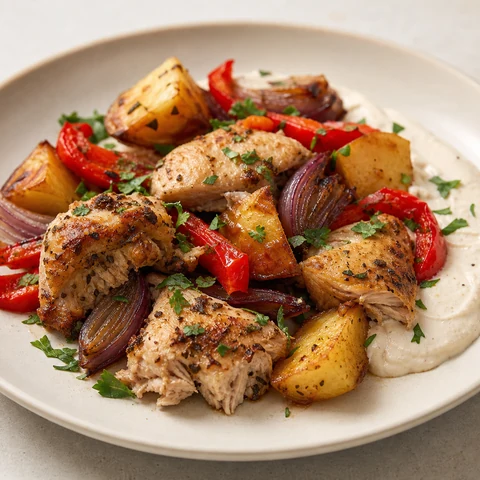
Lemon and Oregano Chicken Traybake with Tahini Yoghurt
Serves 4 · Prep 15 min · Cook 45 min
Chicken thighs roasted on a single tray with potatoes, capsicum and red onion in lemon and oregano, served with a lemony tahini yoghurt.
Ingredients
700 g skinless chicken thigh fillets, halved
900 g potatoes, cut into 3 cm chunks
1 large red capsicum, cut into thick strips (200 g)
1 large red onion, cut into wedges (200 g)
70 ml extra-virgin olive oil (63 g)
3 g dried oregano
3 garlic cloves, crushed (15 g)
30 ml lemon juice (30 g)
400 g greek-style yoghurt
60 g tahini
10 g flat-leaf parsley, chopped
1 g iodised table salt
Ground black pepper, to taste
Approximate per serving
3012 kJ / 720 kcal · protein 47.2 g · carbohydrate 37.4 g · fibre 7.5 g · fat 40.2 g · sodium 302.2 mg
Method
Heat the oven to 220C. Toss the potatoes with a third of the oil, the salt and pepper in the largest roasting tin you own, spread them into one layer and roast 20 minutes.
Meanwhile rub the chicken with the remaining oil, two thirds of the garlic, the oregano and half the lemon juice.
Pull the tin out, turn the potatoes, and tuck the chicken, capsicum and onion in among them. Everything must sit in a single layer with gaps; piled up it steams and stays pale, so use two tins if it will not fit.
Roast a further 25 minutes, until the chicken is browned at the edges and its juices run clear when the thickest piece is pierced, and a potato chunk is crisp outside and gives with no resistance to a knife.
Whisk the yoghurt, tahini, the rest of the garlic and the remaining lemon juice together with two tablespoons of cold water, until it is smooth and pours thickly off the spoon.
Scatter the parsley over the tray and take it to the table with the tahini yoghurt to spoon over each plate.
Safety and storage
Cook to
75°C / 167°F in the centre (poultry, including minced poultry)
Keeps
3 days refrigerated below 5°C
Reheat to
steaming hot, at least 75°C
The Food Safety Information Council table gives poultry, whole or minced, as 75°C in the centre. Colour and clear juices are not a reliable test. Check the thickest part with a thermometer.
Cool it fast: split large amounts into shallow containers as soon as it stops steaming, and have it in the fridge within two hours. Reheat once only, until steaming hot right through, at least 75°C in the centre.
Cooking around the things that genuinely lower the risk of stones returning — fluid, sodium, and keeping dietary calcium adequate rather than cutting it. Which matters most depends on your stone type and your metabolic results, so this belongs alongside your own medical and dietetic care.