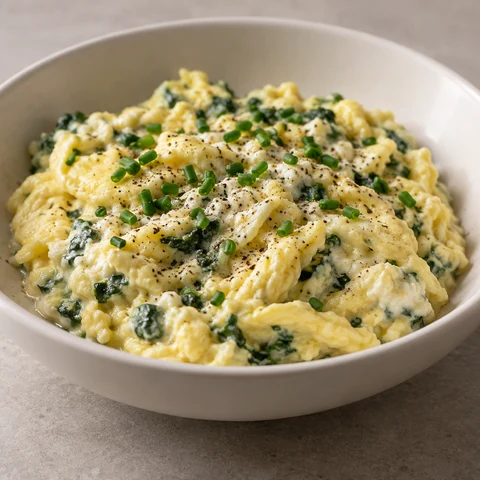
Eggs cooked low and slow into soft set curds with the bread soaked and mashed into them first, ricotta melted through on the heat and spinach chopped fine. A spoon breakfast built so that nothing on the plate asks for a firm bite.
Metric avoids regional spoon ambiguity. US uses 5 mL tsp, 15 mL tbsp and 240 mL cup. Small masses stay in grams unless a verified recipe conversion exists. More on measurements
120 g baby spinach
6 slices soft white bread, weighed after the crusts are cut off, torn into 1 cm pieces (180 g)
150 ml full-cream milk (155 g)
8 eggs (400 g)
20 g unsalted butter
250 g fresh ricotta
10 g chives, snipped fine
Ground black pepper, to taste
Method
Put the spinach in a heatproof bowl and pour boiling water over it so it collapses. Leave it to sit until the leaves are fully wilted, drain, run cold water over it until cool enough to handle, and discard every stem. Gather the leaves into a tight ball and chop across it one way, then turn the board and chop across it the other way, until no piece is longer than 5 mm in any direction; a strand that could wrap around a fork is too long. Squeeze it in your fist until it stops dripping, then fluff it apart with your fingers so it does not go into the pan as a lump.
Warm the milk (30 seconds in the microwave is enough). Put the torn bread in a large bowl, pour the warm milk over, leave 10 minutes, then mash with a fork until it is a smooth paste with no piece bigger than a pea and nothing that springs back when pressed; keep mashing until the fork meets no resistance anywhere. Crack in the eggs and whisk until no streaks of white remain.
Put the ricotta in a small bowl and break it up with a fork until it is loose crumbs with no lump bigger than a pea, then stir the chopped spinach through it so the spinach is dispersed in the ricotta; they go in while the eggs are still cooking, not after, so the whole pan reaches temperature together.
Melt the butter in a non-stick frying pan at least 28 cm across over low heat. Pour in the egg mixture and stir slowly and constantly with a spatula, scraping the base and breaking any curd bigger than a teaspoon as it forms, for 8-10 minutes, until small soft curds have formed and about a quarter of the mixture is still wet. Add the ricotta and spinach now and keep stirring over low-medium heat for 5-6 minutes more, until no liquid egg remains anywhere in the pan, the ricotta is warmed through in small soft flecks, and the whole mass is steaming hot throughout, at least 75C/167F on a probe pushed into the middle of the pan. It should be set in small curds and still creamy, not dry.
Snip the chives into pieces no longer than 2 mm, stir them through the eggs in the pan so they soften in the heat, then spoon into warm bowls and season with pepper. Eat with a spoon.
Serve
In a bowl, with a spoon. The bread has been mashed into the eggs and the spinach cut short in both directions, so it is a soft-set scramble built to need little chewing; on a bad day, leave the chives out.
Tomorrow
Scrambled eggs are best the minute they are made, and this is written to be eaten fresh; the recipe halves cleanly for two. The spinach can be blanched and chopped the night before and kept covered in the fridge. If there are leftovers, they reheat to a firmer texture than the first sitting.
Safety and storage
Keeps
3 days refrigerated below 5°C
Reheat to
steaming hot, at least 75°C
Cool it fast: split large amounts into shallow containers as soon as it stops steaming, and have it in the fridge within two hours. Reheat once only, until steaming hot right through, at least 75°C in the centre.
These options describe ways to change the workload around a written recipe method. They do not certify a recipe as accessible or safe for a particular person, and they do not silently rewrite the written ingredients, quantities, cooking temperatures or food-safety requirements. Trial the real task and use a different method or recipe when a generic workflow change would be inappropriate.
Workflow option
Reduce the chopping step before changing knife technique
If chopping is one of the heavier parts of this method, first check whether the same ingredient can be bought or prepared in a form that removes some knife work.
Consider: Compare pre-cut, frozen, pre-portioned or otherwise prepared versions only where they still perform the same culinary role in this recipe.
Trade-offs
Convenience formats can cost more or use more storage space.
Texture, seasoning, sodium or package size can differ, so check the actual product rather than assuming it is equivalent.
Identify the high-grip step instead of adapting the whole recipe
The recorded method includes at least moderate grip demand, but that demand may come from opening, stabilising, stirring, cookware or another specific step.
Consider: Identify the exact grip-heavy action and trial one change at a time, such as stabilisation, a lower-force opener or lighter cookware where that action actually occurs.
Trade-offs
A tool that reduces one grip demand can add setup, cleaning or another movement.
Do not assume a generic aid fits the hand position, force direction or hot-task sequence in this recipe.
This method has at least moderate lifting or transfer demand, so the heaviest loaded step is worth planning before cooking begins.
Consider: Where the method allows it, consider smaller cookware, split cold loads, sliding across a stable surface or a prepared landing zone rather than carrying one awkward load.
Trade-offs
Splitting a load can add trips, pours or cleanup, so it is useful only when the complete sequence is easier to control.
Hot transfers need a clear destination and should not be improvised after the vessel is already loaded.
Compare a no-drain method instead of improvising the liquid ratio
The written method includes stovetop draining, which is a distinct hot-water transfer rather than a small wording detail.
Consider: Do not generically rewrite water or liquid quantities. Compare a tested no-drain cooking method or another recipe whose written method already avoids stovetop draining.
Trade-offs
A no-drain technique can change texture or timing and is not automatically interchangeable with the written method.
Changing liquid ratios without recipe development can affect doneness and food safety.
This method contains a recorded hot-liquid transfer, so route, load and landing position matter more than simply shortening the written step.
Consider: Clear the destination and route first; reduce the load only when that genuinely simplifies the sequence. If the transfer remains the main barrier, compare recipes whose written methods do not contain one.
Trade-offs
Extra pours can create additional spill opportunities even when each container is lighter.
A shorter route is not useful if it ends at an unstable or unreachable landing surface.
The method includes high bimanual demand, so look for steps where one hand is expected to hold or stabilise while the other cuts, opens, stirs or pours.
Consider: Stabilise the stationary part of the task where appropriate, or change the order so one hand is not being asked to perform two jobs at once.
Trade-offs
Clamps, spikes, mats and other stabilisers introduce their own pinch, puncture or setup considerations.
Reordering a workflow must not separate steps that depend on immediate timing, temperature or food safety.
Recipes whose current method review records low visual reliance, making them useful examples when comparing methods that depend less heavily on visual checking.
Eggs cooked low and slow into soft set curds with the bread soaked and mashed into them first, ricotta melted through on the heat and spinach chopped fine. A spoon breakfast built so that nothing on the plate asks for a firm bite.
Ingredients
120 g baby spinach
6 slices soft white bread, weighed after the crusts are cut off, torn into 1 cm pieces (180 g)
150 ml full-cream milk (155 g)
8 eggs (400 g)
20 g unsalted butter
250 g fresh ricotta
10 g chives, snipped fine
Ground black pepper, to taste
Approximate per serving
1684 kJ / 402.6 kcal · protein 25.6 g · carbohydrate 25 g · fibre 2.3 g · fat 21.7 g · sodium 493.8 mg
Method
Put the spinach in a heatproof bowl and pour boiling water over it so it collapses. Leave it to sit until the leaves are fully wilted, drain, run cold water over it until cool enough to handle, and discard every stem. Gather the leaves into a tight ball and chop across it one way, then turn the board and chop across it the other way, until no piece is longer than 5 mm in any direction; a strand that could wrap around a fork is too long. Squeeze it in your fist until it stops dripping, then fluff it apart with your fingers so it does not go into the pan as a lump.
Warm the milk (30 seconds in the microwave is enough). Put the torn bread in a large bowl, pour the warm milk over, leave 10 minutes, then mash with a fork until it is a smooth paste with no piece bigger than a pea and nothing that springs back when pressed; keep mashing until the fork meets no resistance anywhere. Crack in the eggs and whisk until no streaks of white remain.
Put the ricotta in a small bowl and break it up with a fork until it is loose crumbs with no lump bigger than a pea, then stir the chopped spinach through it so the spinach is dispersed in the ricotta; they go in while the eggs are still cooking, not after, so the whole pan reaches temperature together.
Melt the butter in a non-stick frying pan at least 28 cm across over low heat. Pour in the egg mixture and stir slowly and constantly with a spatula, scraping the base and breaking any curd bigger than a teaspoon as it forms, for 8-10 minutes, until small soft curds have formed and about a quarter of the mixture is still wet. Add the ricotta and spinach now and keep stirring over low-medium heat for 5-6 minutes more, until no liquid egg remains anywhere in the pan, the ricotta is warmed through in small soft flecks, and the whole mass is steaming hot throughout, at least 75C/167F on a probe pushed into the middle of the pan. It should be set in small curds and still creamy, not dry.
Snip the chives into pieces no longer than 2 mm, stir them through the eggs in the pan so they soften in the heat, then spoon into warm bowls and season with pepper. Eat with a spoon.
Serve
In a bowl, with a spoon. The bread has been mashed into the eggs and the spinach cut short in both directions, so it is a soft-set scramble built to need little chewing; on a bad day, leave the chives out.
Tomorrow
Scrambled eggs are best the minute they are made, and this is written to be eaten fresh; the recipe halves cleanly for two. The spinach can be blanched and chopped the night before and kept covered in the fridge. If there are leftovers, they reheat to a firmer texture than the first sitting.
Safety and storage
Keeps
3 days refrigerated below 5°C
Reheat to
steaming hot, at least 75°C
Cool it fast: split large amounts into shallow containers as soon as it stops steaming, and have it in the fridge within two hours. Reheat once only, until steaming hot right through, at least 75°C in the centre.
Real meals made mechanically easier to eat when chewing hurts. That is a job about texture and chewing rather than swallowing (dysphagia) guidance, and it is not a treatment for TMD itself.