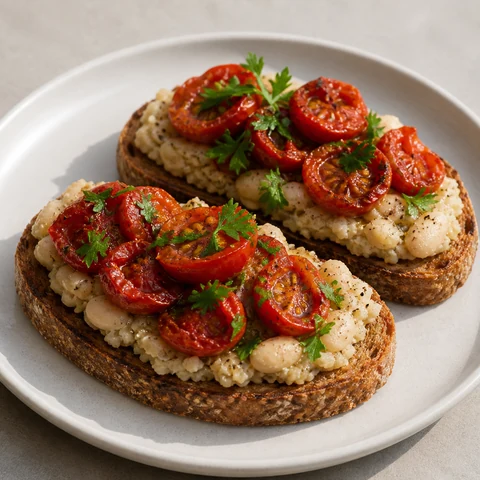
Cannellini beans crushed with olive oil, garlic and lemon into a savoury spread, on wholegrain toast with tomatoes. Beans for breakfast is the good idea nobody expects.
Metric avoids regional spoon ambiguity. US uses 5 mL tsp, 15 mL tbsp and 240 mL cup. Small masses stay in grams unless a verified recipe conversion exists. More on measurements
400 g canned no-added-salt cannellini beans, drained and rinsed
4 slices wholegrain bread (160 g)
250 g cherry tomatoes, halved
30 ml extra-virgin olive oil (27 g)
1 garlic clove, crushed (5 g)
20 ml lemon juice (20 g)
12 g flat-leaf parsley, chopped
0.5 g iodised table salt
Ground black pepper, to taste
Method
Warm a third of the oil in a small pan over medium heat and cook the tomatoes cut-side down for 5 minutes, until they collapse.
Crush the beans in a bowl with a fork, the rest of the oil, the garlic, lemon juice, salt and plenty of pepper. Leave it coarse: a purée goes gluey and a crushed mash keeps some texture.
Toast the bread.
Spread the beans thickly on the toast, spoon the tomatoes over and scatter the parsley.
Tomorrow
The bean mash keeps well and is arguably better on the second day; the toast does not. Keep the mash and the tomato, and toast fresh bread.
Safety and storage
Keeps
3 days refrigerated below 5°C
Reheat to
steaming hot, at least 75°C
Cool it fast: split large amounts into shallow containers as soon as it stops steaming, and have it in the fridge within two hours. Reheat once only, until steaming hot right through, at least 75°C in the centre.
These options describe ways to change the workload around a written recipe method. They do not certify a recipe as accessible or safe for a particular person, and they do not silently rewrite the written ingredients, quantities, cooking temperatures or food-safety requirements. Trial the real task and use a different method or recipe when a generic workflow change would be inappropriate.
Workflow option
Move non-heat preparation to a seated workstation
Some or all preparation may be separable from the heat-side work, even when the complete recipe cannot be performed from one position.
Consider: Stage ingredients and complete suitable measuring, opening and cold preparation at a stable seated station before the stove or oven is active, while keeping heat-side tasks as a separate plan.
Trade-offs
Moving prep can increase carrying if ingredients and tools are stored far from the seated station.
Perishable foods still require normal temperature control during staged preparation.
Recipes whose current method review records low visual reliance, making them useful examples when comparing methods that depend less heavily on visual checking.
Cannellini beans crushed with olive oil, garlic and lemon into a savoury spread, on wholegrain toast with tomatoes. Beans for breakfast is the good idea nobody expects.
Ingredients
400 g canned no-added-salt cannellini beans, drained and rinsed
4 slices wholegrain bread (160 g)
250 g cherry tomatoes, halved
30 ml extra-virgin olive oil (27 g)
1 garlic clove, crushed (5 g)
20 ml lemon juice (20 g)
12 g flat-leaf parsley, chopped
0.5 g iodised table salt
Ground black pepper, to taste
Approximate per serving
2367 kJ / 565.7 kcal · protein 26.3 g · carbohydrate 61.4 g · fibre 26.2 g · fat 17 g · sodium 462.8 mg
Method
Warm a third of the oil in a small pan over medium heat and cook the tomatoes cut-side down for 5 minutes, until they collapse.
Crush the beans in a bowl with a fork, the rest of the oil, the garlic, lemon juice, salt and plenty of pepper. Leave it coarse: a purée goes gluey and a crushed mash keeps some texture.
Toast the bread.
Spread the beans thickly on the toast, spoon the tomatoes over and scatter the parsley.
Tomorrow
The bean mash keeps well and is arguably better on the second day; the toast does not. Keep the mash and the tomato, and toast fresh bread.
Safety and storage
Keeps
3 days refrigerated below 5°C
Reheat to
steaming hot, at least 75°C
Cool it fast: split large amounts into shallow containers as soon as it stops steaming, and have it in the fridge within two hours. Reheat once only, until steaming hot right through, at least 75°C in the centre.
Mediterranean-style everyday cooking with less added sugar and fewer sweetened drinks, which is where current MASLD guidance points. Whether your liver has changed is a clinical question: diagnosis, fibrosis staging and medicines stay with your team.