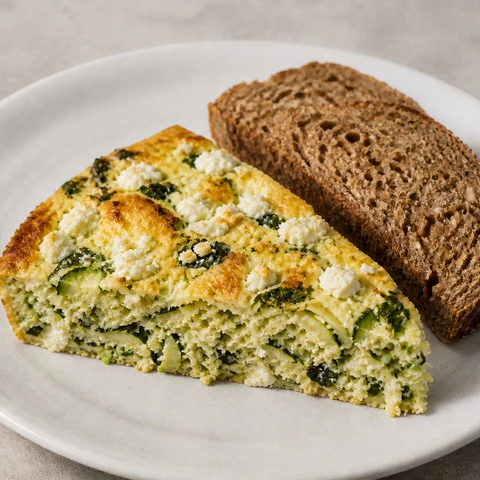
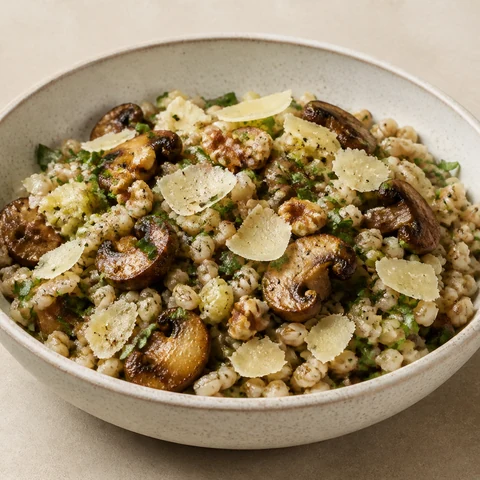
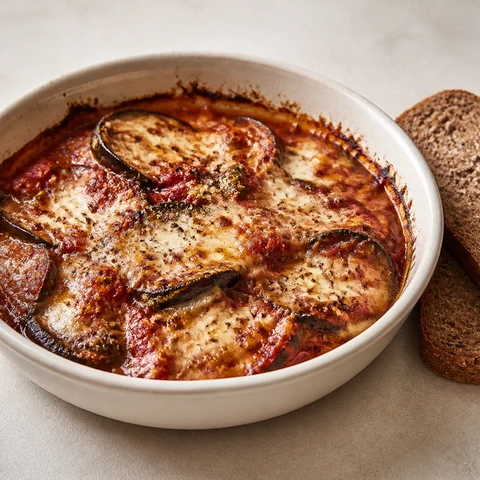
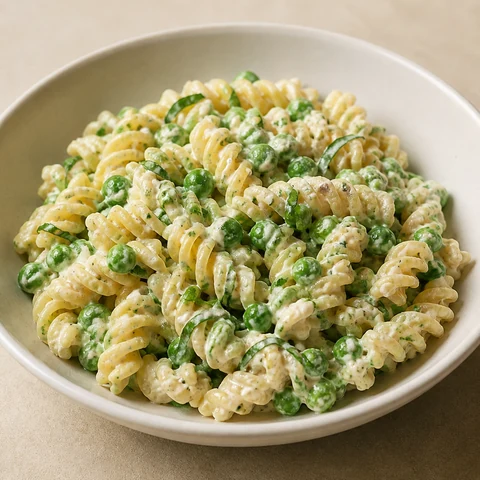
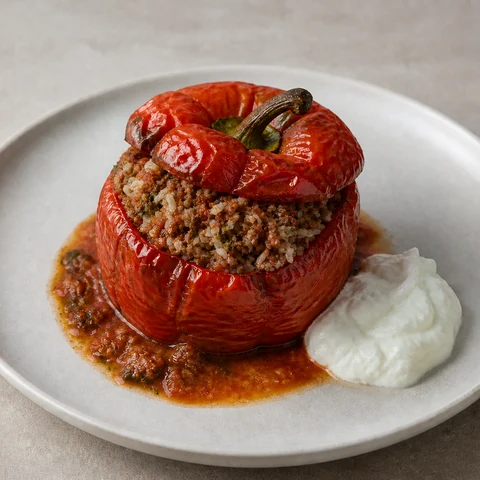
Everyday Mediterranean-style cooking, which has promising early evidence in psoriasis and is good eating in its own right. Food like this sits alongside the care your clinician gives you rather than replacing any of it.
Drinkers are more likely to have psoriasis, but the association does not survive a genetic test of cause. What does survive is the effect of alcohol on how well psoriasis treatment works, and on a liver that is already carrying more risk than most.
Coeliac disease is about twice as common in people with psoriasis. That makes gluten worth investigating and makes going gluten-free first the wrong move, because it destroys the test.
Broad food elimination is popular in psoriasis because it feels like doing something. As an experiment it is incapable of producing an answer, and there is a cheaper one.
Psoriatic disease travels with cardiometabolic risk, and that is where eating well has its clearest job. Judging every meal by your plaques is a scoreboard nobody can win.
Vitamin D, fish oil, probiotics and curcumin have all been tested. The results fail in the same shape every time, and that shape tells you what to ask before you buy.
Every psoriasis food list online is longer than the research behind it. This one is built the other way round: what the trials and the professional guidance will put their name to, what they will not, and what that leaves on the plate.
Milk, cheese and yoghurt sit near the top of most psoriasis avoid-lists. Current evidence does not support avoiding them for everyone, the professional recommendations do not mention them, and the one large survey of what people with psoriasis eat found they were already short of dairy and calcium.
Tomatoes, capsicum, eggplant and potatoes top the psoriasis avoid-lists. The randomised trial that improved psoriasis with a Mediterranean diet, run at a Madrid clinic, taught an eating pattern in which tomatoes are a staple. This is where the nightshade claim comes from, why it survives, and what a person who still suspects a tomato should do.
People with psoriasis measurably have lower vitamin D than people without it. Four pooled analyses of the supplement trials disagree about whether a tablet does anything for the skin, and the best of them is small and uncertain. What that means for a blood test, a supplement and a plate.
A large prospective cohort linked ultra-processed food with developing psoriasis, and smaller studies link sugary drinks and poor diet quality with worse disease and weaker treatment response. This is what those findings can and cannot say, and the one change in the trolley they point at.
Thirteen randomised trials, pooled in 2026, say weight loss improves psoriasis severity and quality of life with high certainty. The largest single trial nearly doubled the response to systemic treatment. What the numbers are, who they apply to, how the Mediterranean trial fits, and why none of it is a promise of clear skin.
Anti-inflammatory diet is the most searched psoriasis diet and the least defined: no two lists agree, and none of them has been trialled under that name. One eating pattern that fits every description of it has been, in a randomised trial, and it is the Mediterranean diet. What the label means, what has evidence, and what an anti-inflammatory week looks like when it is built from the trial rather than the listicle.
Turmeric is on every anti-inflammatory list for psoriasis. The randomised trial behind the claim tested engineered curcumin nanoparticles as an add-on to acitretin in moderate-to-severe disease, and the 2025 pooled analysis of supplements found curcumin lowered one cytokine while rating the whole field low-to-moderate certainty. What that means for the jar in your cupboard, and for the capsules.
The gut microbiome in psoriasis is measurably different from healthy controls, and a meta-analysis of seven trials found probiotics as an add-on lowered the severity index. The strains, doses and durations differ in every trial, the reviews all end by asking for larger ones, and no guideline recommends a capsule. What is real here, what is early, and where yoghurt fits.
A systematic review of eighteen randomised trials found fish oil on its own did nothing for psoriasis severity, and fish oil added to conventional treatment lowered it. The 2025 supplement meta-analysis rates the field low-to-moderate certainty, and no guideline recommends the capsule. The fish itself is a different matter, because it is in the one diet with a trial.
Seven in ten people who tried a vegan diet for psoriasis reported it helped, and a UK survey linked more plant protein with lower odds of severe disease. Neither is a trial, and the trial that exists is of a pattern with fish and dairy in it. What the plant-based evidence actually shows, how it overlaps with the Mediterranean result, and what a plant-forward psoriasis week looks like.
Every statement in these guides is recorded as a claim with its sources and the rule attached to it. Read the claim ledger for psoriasis — 34 claims, each separately citable.
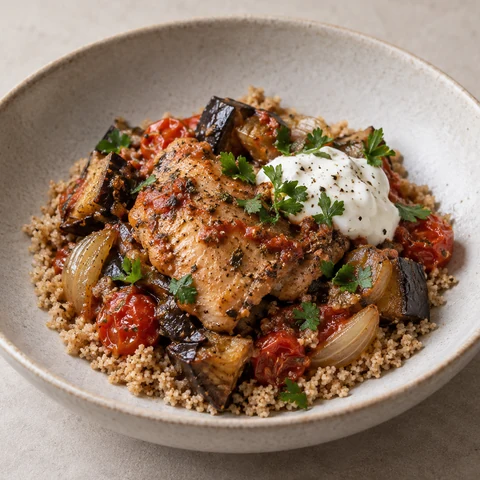
Chicken thighs roasted on a tray of eggplant, cherry tomatoes and onion until the eggplant collapses and the tomatoes burst into a sauce, with oregano and olive oil, on couscous with a spoon of yoghurt.